
Considering a non-invasive treatment like botox, PRP, profhilo or microneedling? Book a free consulation at our Richmond Hill clinic today.
[Updated September 17, 2026]
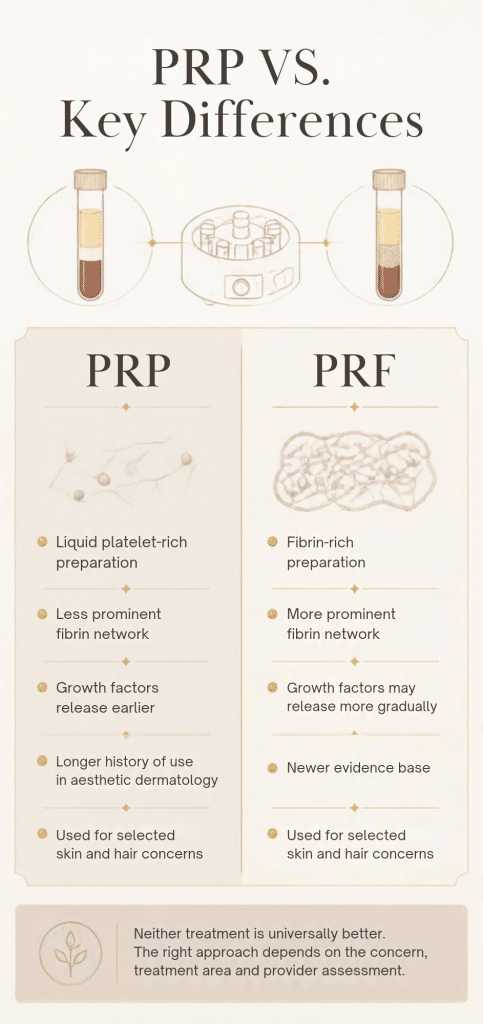
PRP vs PRF mainly differs in how the blood sample is processed and the final platelet-rich product that is produced.
PRP, or platelet-rich plasma, creates a liquid plasma concentrate that contains platelets and growth factors. PRF, or platelet-rich fibrin, forms a fibrin-rich product that can release growth factors more gradually.
Both treatments use components from your own blood and may be used for skin rejuvenation or hair-related concerns. However, current research does not show that one option is universally better for every patient or treatment goal.
At Dermatouch in Richmond Hill, PRP and PRF form part of our regenerative skin and hair treatment options.
PRP stands for platelet-rich plasma.
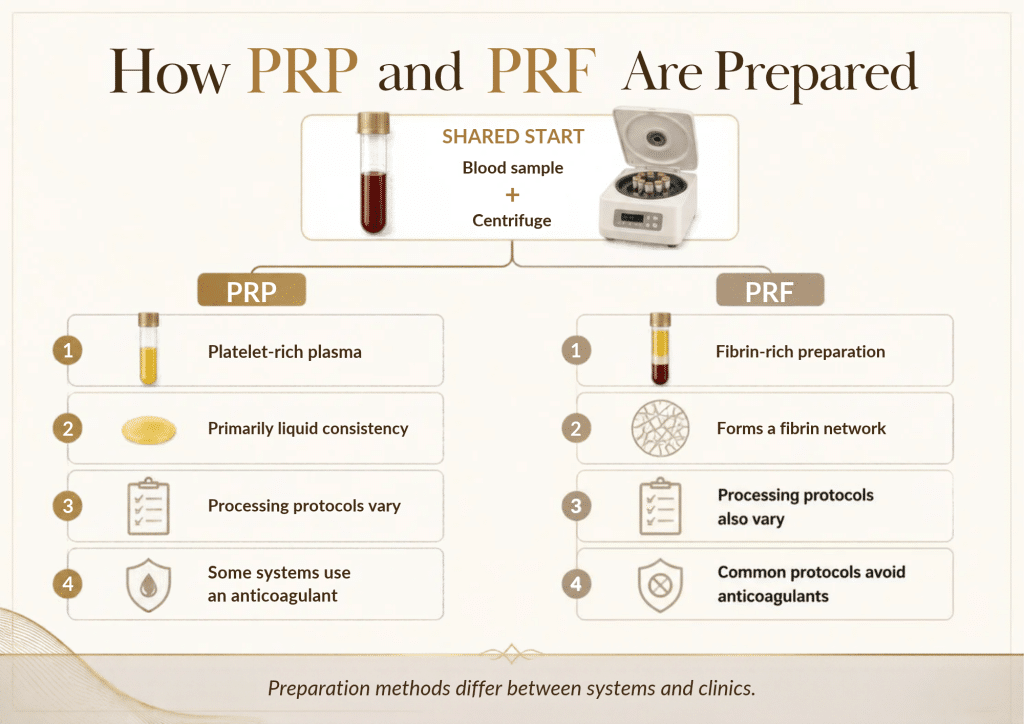
A provider draws a small amount of blood and processes it in a centrifuge to separate and concentrate platelet-rich plasma.
Platelets contain proteins and growth factors involved in tissue repair. In aesthetic medicine, providers may use PRP for concerns such as skin quality, acne scars and some forms of hair thinning.
Research on PRP in aesthetic dermatology has reported potential benefits for skin rejuvenation and hair restoration, although protocols differ considerably between studies.
At Dermatouch, PRP may also be combined with professional microneedling for selected skin concerns.
PRF stands for platelet-rich fibrin.
Like PRP, PRF begins with a sample of your own blood. The preparation method differs, producing a fibrin network that can trap platelets and other blood components.
That fibrin structure is one of the main reasons researchers are interested in PRF. Laboratory studies suggest injectable PRF can release some growth factors over a longer period than PRP.
However, preparation methods vary considerably, and researchers have not established one standardized PRF protocol.
You can also review Dermatouch’s PRF treatment page for current clinic information.
The main differences involve processing, consistency and growth-factor release.
| PRP | PRF | |
|---|---|---|
| Full name | Platelet-rich plasma | Platelet-rich fibrin |
| Final product | Primarily liquid plasma | Fibrin-rich product |
| Fibrin network | Less prominent | More prominent |
| Growth-factor release | Often occurs earlier | May occur more gradually |
| Preparation | Protocols vary | Protocols also vary |
| Research base | More established in dermatology | Newer and still developing |
| Potential uses | Skin and hair concerns | Skin and hair concerns |
This comparison is more accurate than describing PRF simply as a “stronger” or “advanced” version of PRP.
A 2025 systematic review found that injectable PRF showed higher platelet concentrations and more sustained growth-factor release in several studies, but the authors also noted that the clinical evidence remains limited and highly variable across medical fields.
Current evidence does not support saying that PRF is always better than PRP.
Some laboratory and early comparative studies suggest PRF may provide a more sustained release of growth factors. However, clinical outcomes depend on the treatment indication, preparation method, injection technique and individual patient factors.
For hair restoration specifically, a 2024 review concluded that larger, well-designed studies are still needed to confirm whether PRF provides benefits beyond PRP.
The better question is therefore not “Which treatment is stronger?” but which treatment approach fits the concern being treated and the provider’s protocol.
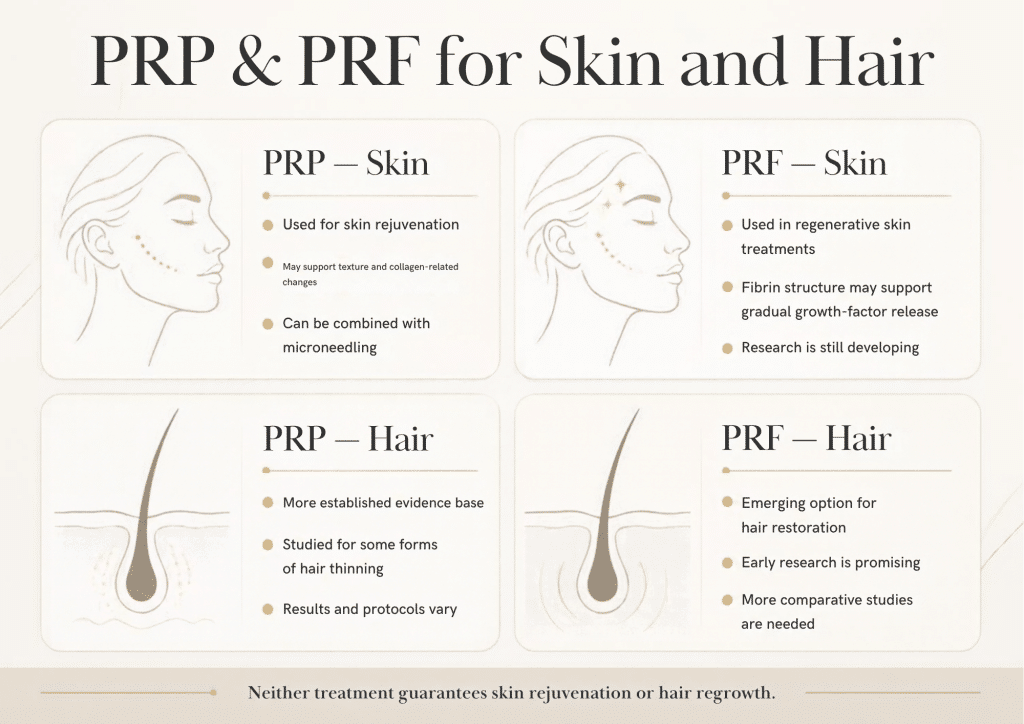
Both PRP and PRF may be used within skin-rejuvenation treatment plans, but the evidence base is not identical.
PRP has a larger body of research in aesthetic dermatology. Studies have examined its use for facial rejuvenation, scars and wound healing.
PRF is newer in cosmetic dermatology. Its fibrin structure and slower release pattern make it an area of growing interest, but current reviews continue to emphasize variation in preparation methods and clinical outcomes.
A consultation can help determine which option, if either, may suit the treatment area and concern.
Choosing the right treatment depends on your goals, skin quality, age, and the severity of your concerns. Here are a few simple PRP currently has a more established evidence base for some forms of hair loss.
Research suggests PRP may improve hair density in some patients with androgenetic alopecia, although treatment protocols and results vary.
PRF is also being studied for hair restoration. Early research is promising, but a 2024 review found that there is still no consensus on the best PRF preparation method and that larger comparative studies are needed before PRF can be considered superior to PRP.
Neither treatment should be presented as guaranteed hair regrowth.
This distinction matters.
Growth-factor release duration describes what happens biologically within the platelet preparation.
Treatment longevity describes how long a patient notices a clinical effect.
Those are not the same thing, and current research does not support a universal claim that PRF results always last longer than PRP.
Both treatments use components collected from your own blood.
However, the exact preparation systems differ.
Some PRP systems use anticoagulants during processing. PRF protocols commonly avoid anticoagulants so a fibrin network can form.
Because preparation methods vary between systems and clinics, broad claims such as “100% natural” can oversimplify the treatment.
The general process is similar for both treatments.
The specific technique depends on the treatment area and clinical protocol.
PRP and PRF generally involve a relatively short visible recovery period, but reactions vary.
Temporary effects may include:
When combined with microneedling, skin recovery may also include temporary dryness, tightness or flaking.
Patients should follow the aftercare instructions provided by their treatment professional.
PRP and PRF are not risk-free simply because they use components from your own blood.
Potential risks can include:
The risks can also depend on the treatment area, preparation method and injection technique.
A provider should review your medical history and discuss relevant risks before treatment.
PRP or PRF may not be appropriate for everyone.
Your provider may recommend postponing or avoiding treatment depending on factors such as:
Suitability requires an individual assessment.
There is no universal number of treatments for either PRP or PRF.
Treatment frequency depends on:
Some treatment plans use a series of sessions followed by maintenance, while others may use a different schedule.
Your provider should recommend a plan after assessing your goals and response to treatment.
Dermatouch publishes current PRP and PRF pricing on its treatment prices page.
Because pricing, packages and promotions can change, linking to the live pricing page keeps this article accurate over time. The current pricing page lists PRP hair-loss therapy as well as PRF options for the face, under-eye area, face and neck, and hair concerns.
The decision should depend on your concern, treatment area and provider assessment rather than assuming that PRF is automatically an upgrade from PRP.
You may discuss PRP when:
You may discuss PRF when:
These are not strict rules. The evidence does not currently support a simple “PRP for mild problems and PRF for severe problems” distinction.
PRP and PRF are related regenerative treatments, but they are not identical.
PRP produces platelet-rich plasma with a longer clinical research history in dermatology. PRF forms a fibrin-rich preparation that may release growth factors more gradually, although comparative clinical evidence is still developing.
Dermatouch offers both PRP and PRF treatments in Richmond Hill for selected skin and hair concerns. A personalized consultation can help determine which treatment approach may be appropriate for your goals.