
Considering a non-invasive treatment like botox, PRP, profhilo or microneedling? Book a free consulation at our Richmond Hill clinic today.
[Updated September 18, 2026]
PRF for stretch marks is a regenerative treatment approach that uses platelet-rich fibrin prepared from a small sample of your own blood. Providers may inject PRF or combine it with treatments such as microneedling to support the skin’s repair and collagen-remodelling processes.
Early research suggests platelet-based treatments may improve the appearance of some stretch marks, but results vary and the evidence for PRF specifically remains limited. No treatment can completely remove stretch marks.
At Dermatouch in Richmond Hill, PRF treatments are available for selected skin concerns following an individual assessment.
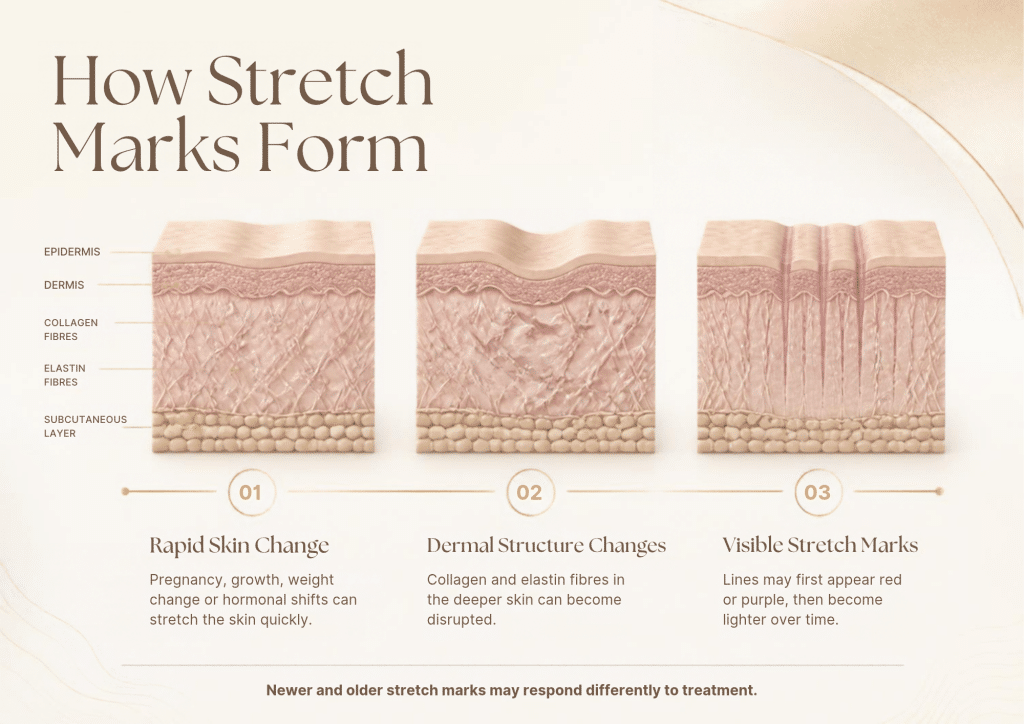
Stretch marks, medically known as striae distensae, are lines that develop when the skin changes rapidly and its underlying structure cannot adapt at the same rate.
They commonly appear after:
Researchers commonly describe newer red or purple stretch marks as striae rubrae and older pale or white stretch marks as striae albae.
Treatment can be challenging, and the response may differ depending on the age, colour and location of the stretch marks. Recent reviews have not identified a single treatment that consistently works for everyone.
PRF stands for platelet-rich fibrin.
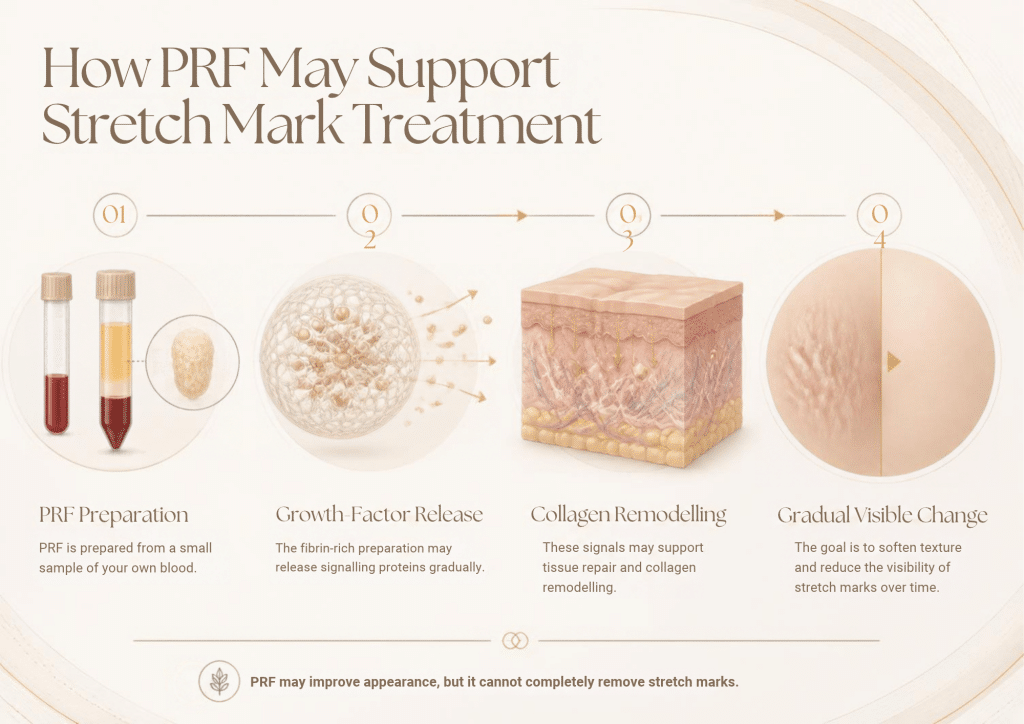
A provider draws a small sample of your blood and processes it in a centrifuge. This separates a platelet- and fibrin-rich portion that contains components involved in normal tissue repair.
One feature that distinguishes PRF from traditional PRP is its fibrin network. Research comparing platelet preparations suggests that injectable PRF may release some growth factors more gradually than PRP. However, preparation methods vary, and researchers have not established one universal PRF protocol.
That biological difference is interesting, but it does not mean PRF automatically produces better cosmetic results.
PRF may support processes involved in tissue repair and collagen remodelling.
Stretch marks involve structural changes within the dermis, including changes in collagen and elastin. Platelet-based treatments have therefore attracted interest because platelets release signalling proteins involved in healing and tissue repair.
Potential treatment goals include:
These are potential effects, not guaranteed outcomes.
Much of the available stretch-mark research involves PRP rather than PRF. A systematic review of PRP found some clinical improvement across small studies, but the authors concluded that the overall quality of evidence was poor.
Direct research on PRF for stretch marks is still limited.
A randomized comparative study published in 2025 treated abdominal stretch marks with microneedling plus PRF on one side and microneedling plus PRP on the other. Both sides improved significantly.
The PRF-treated side showed some favourable findings, but researchers found no statistically significant difference between the two treatments for several major outcomes, including stretch-mark width, global aesthetic improvement and patient satisfaction.
This is encouraging early evidence, but one relatively small study does not establish PRF as a proven or superior treatment.
A broader 2026 systematic review of stretch-mark treatments also concluded that current evidence does not support one single best treatment and that combination approaches may sometimes improve outcomes.
The age and appearance of stretch marks can affect treatment response.
Newer stretch marks often appear red, pink or purple. Older stretch marks typically become lighter and more scar-like over time.
Research across stretch-mark treatments suggests these two stages may respond differently, which is why a provider should assess the type of stretch mark rather than recommend the same treatment for everyone.
There is not enough PRF-specific evidence to say confidently that PRF works better for either new or older stretch marks.
PRF may be combined with microneedling as part of a treatment plan.
Microneedling creates controlled microchannels in the skin and triggers a wound-healing response. Providers may then incorporate platelet-based preparations such as PRF into the treatment approach.
The 2025 comparative study of abdominal stretch marks used PRF together with microneedling rather than PRF alone. Both the PRF and PRP combination treatments produced improvement.
Dermatouch also offers professional microneedling for selected skin concerns.
A PRF appointment may include several stages.
Your provider examines the treatment area, reviews your health history and discusses your goals.
The provider collects a small sample of your blood.
A centrifuge processes the blood according to the PRF protocol.
Depending on the treatment plan, the provider may inject PRF or use it alongside another procedure such as microneedling.
Your provider explains how to care for the treated area and what temporary reactions to expect.
The exact procedure can vary according to the area and treatment method.
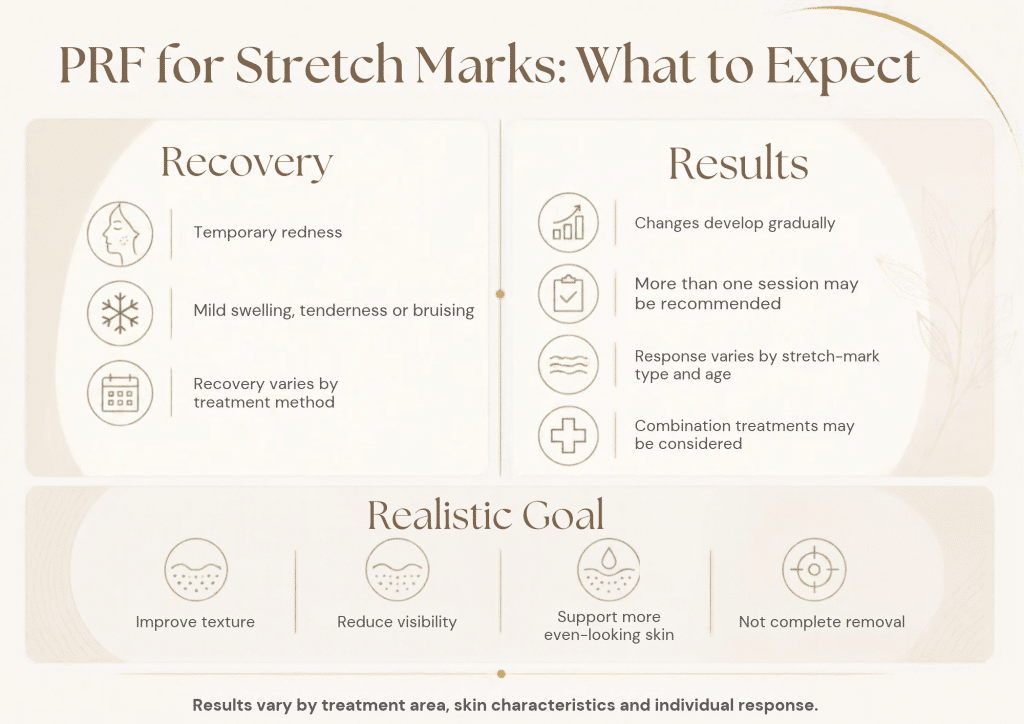
Recovery varies depending on whether PRF is injected, combined with microneedling or used as part of another procedure.
Temporary effects can include:
Microneedling may also cause temporary dryness, tightness or flaking.
Most importantly, avoid promising a universal “one or two days” of downtime. Treatment depth, area and individual skin response all affect recovery.
Changes from regenerative treatments generally develop gradually rather than immediately.
Because stretch marks involve structural changes within the skin, improvement may take time and may require more than one treatment.
However, there is not enough high-quality evidence to promise that everyone will see results within 4–6 weeks, as the current article does.
A more accurate expectation is:
Visible changes vary by the type and age of the stretch marks, treatment method, number of sessions and individual skin response.
There is no universally established PRF treatment schedule for stretch marks.
The 2025 study using PRF with microneedling used three monthly sessions, but that research protocol should not automatically become a recommendation for every patient.
A provider should determine the treatment schedule based on:
This is better than stating universally that “3–4 sessions” produce the best results.
No treatment can reliably erase stretch marks completely.
The realistic goal is usually to reduce their visibility or improve their texture, not restore the skin to exactly how it looked before stretch marks developed.
A systematic review covering 151 stretch-mark studies found substantial variation across treatments and outcomes, reinforcing that results differ considerably between patients and treatment types.
This is an important GEO section because it directly answers a high-intent patient question without overpromising.
PRF is only one potential approach.
Research has evaluated treatments including:
A 2026 systematic review found evidence for several treatment categories but concluded that the available research still does not establish one universally preferred treatment.
The appropriate approach depends on factors such as stretch-mark type, skin tone, treatment area and individual goals.
PRF uses components from your own blood, but that does not make treatment risk-free.
Potential effects can include:
When PRF is combined with another treatment, such as microneedling, the risks and recovery associated with that procedure also apply.
A provider should review relevant risks and suitability before treatment.
PRF may not suit everyone.
A provider may postpone or avoid treatment depending on factors such as:
Suitability requires an individual consultation.
PRF is an emerging regenerative option for people interested in improving the appearance of stretch marks, particularly when providers combine it with treatments such as microneedling.
Early research is encouraging, but current evidence does not support describing PRF as a guaranteed, permanent or universally superior stretch-mark treatment.
Dermatouch offers PRF treatments in Richmond Hill for selected skin concerns. A consultation can help determine whether PRF, microneedling or another treatment approach may suit your skin and goals.
Book a consultation with Dermatouch to discuss your options.